State of research on cognitive offloading · As of October 2026
Work WITH AI.
Not BY AI.
AI makes us faster. Whether it also makes us smarter depends on the order: who thinks first, the human or the machine?
A curated collection by Roger Basler de Roca, continuously updated.
At a glance
What happens
AI raises performance immediately. Whether your own ability grows with it only shows once the AI is gone.
What decides
The order. Those who first commit to their own position and then check the AI lose nothing without AI. Those who adopt AI answers directly reason less well afterwards.
What works
Built-in friction instead of good intentions: own work before the AI, a justification before every adoption.
- 1Think first
- 2Let the AI push back
- 3Adopt only what you can justify
TEDxSchaan talk
How small Language Models in AI could reform Education
The video only loads from YouTube after you click (without cookies, youtube-nocookie.com).
Faster, not smarter
People have always offloaded thinking. The calendar remembers appointments, the calculator calculates, the search engine recalls facts. Research calls this cognitive offloading, and it is a smart strategy: working memory is limited, and what has been offloaded no longer burdens it.
Generative AI changes the nature of offloading. Earlier tools stored information. AI produces the product of thinking itself: the argument, the analysis, the decision memo. This moves outward precisely the work through which competence is built.
The result is a paradox. Performance with AI rises immediately and visibly. Ability without AI can decline at the same time, and that only shows later, when the tool is missing. Short-term productivity and long-term competence drift apart.
"Offloading is not a mistake. It becomes risky where people hand over the work of judgement through which their judgement develops."
Who thinks first? Order in the experiments
Pick a workflow and see how, according to the studies, it affects the result, unaided performance afterwards and memory of your own work.
- KI
AI generates
- M
Human adopts
- KI
AI text stays
Faster and visibly better. Afterwards these people argued more weakly without AI than the no-AI group (−0.38 points), and those who wrote with an LLM could hardly quote their own texts correctly.
Schematic illustration, not measured data. Bars show directions from the cited studies, not their effect sizes. Effects were measured short term, mostly within one session.
−0.38
points weaker independent reasoning (scale 1–7) after AI texts were adopted directly. Measured without AI, 15 to 20 minutes later.
65% → 41%
acceptance of faulty AI suggestions without and with a written justification requirement.
7.5%
of students' AI conversations showed genuine sparring mode.
+26–31 pp
productivity of IT apprentices on tasks outside their training, with AI.
Work WITH AI, not BY AI
The studies point to three places where it is decided whether AI extends or replaces thinking: what the human brings in, how they work with the machine, and what they adopt in the end. These yield three competences, the three-pillar model.
1
Input competence
What you put in
Before the AI produces something, you produce something.
In practice
- Two minutes before the prompt: sketch your own answer, even if it is incomplete.
- Note your criteria: how will I recognise a good result?
- Decide which categories of work go to AI and which deliberately do not.
- Reinvest the time saved: question assumptions, test arguments.
2
Dialogue competence
How you work with the machine
Let the AI push back instead of letting it deliver.
In practice
- Structure prompts with GCES: goal, context, format, source.
- Ask the AI specifically for weaknesses in your own position.
- Request explanations and reasoning instead of finished solutions.
- Treat time pressure as a warning sign: under pressure, people delegate more than is good for them.
3
Review competence
What you adopt
Adopt only what you can justify and defend without the machine.
In practice
- Justify every adoption in one sentence.
- Check AI output with HALT: origin, omission, logic, factual core.
- The no-screen test: could I explain and defend the result in a meeting?
- Watch for uniformity: does the result sound like everything else?
For leaders: what works belongs in the system
The most effective interventions in the experiments were not appeals but built-in friction: a lock that only releases the AI after one's own position is recorded, or a requirement to justify every adoption. Relying on individuals to be disciplined, or on juniors to coach seniors, stays at the level of the individual project. Prompt libraries, review tools, clear usage rules and learning arrangements help decide whether a team works with AI or through it.
Do you work WITH or BY AI?
Statement 1 of 6
Before I ask AI, I have a first answer of my own in my head or on paper.
A reflection aid, not a scientific measurement instrument. No data is stored.
Evidence map
All studies in this collection, with design, sample, finding and limitations. Each study carries a status label so it stays visible how robust a finding is.
- Peer-reviewed: reviewed in a scholarly journal
- Preprint: public, not yet peer-reviewed
- Discussion Paper: working paper of a research institute
- Secondary source: known only through a third-party summary, primary study not independently verified
Risks
Conditions
Interventions that work
Organisation and vocational education
How the question has shifted
2025 · Whether
First studies measure deficits: weaker neural connectivity when writing with AI, dependence, a convergence of thinking. The debate: does AI harm thinking?
Spring 2026 · When
Studies show that the way AI is used matters. Sparring preserves higher-order thinking, substitution cuts it short. Half-hearted use sometimes performs worse than no AI at all.
Autumn 2026 · How
Randomised experiments isolate the order. Those who first commit to their own position and then use AI as a reviewer lose nothing in the subsequent task without AI. Those who adopt AI answers directly lose measurably.
Open · How long
Hardly any study measures over months whether the effects last. This is where research on vocational education comes in.
What we know and what we don't
Well supported (with caution)
- The order of interaction influences immediate independent performance. Several randomised studies show this.
- A justification requirement reduces the adoption of faulty AI suggestions.
- AI increases productivity in the short term, including for early-career workers and outside one's own training.
Open
- Do the effects last for months? Almost all experiments measure within one session or one course.
- Which mechanism is at work? Self-generation, effort and autonomy cannot yet be separated.
- Does this hold in vocational education? Most samples come from universities.
- Does AI-supported extension become one's own competence, or does it remain borrowed?
Research in Progress
The research project
Roger Basler de Roca studies cognitive offloading where research has been thinnest so far: in vocational education and training in the DACH region, with a view to what remains of AI-supported performance in the long term.
"How does the use of AI-supported learning systems influence cognitive offloading and long-term cognitive competence among learners in vocational further education?"
This collection is continuously expanded. Suggestions for new studies: mail@rogerbasler.ch
Thoughts by Roger Basler de Roca
"The biggest risk of AI is not that it can do too much. It is that we unlearn what we could do without it."
"We are getting better at finding information, but worse at actually understanding it."
"Data competence, dialogue competence, verification competence. Whoever has these three need not fear AI."
"The best question to an AI begins with clarity about your own goal."
"We are not automating work. We are automating decisions. And that is exactly where it gets dangerous."
"Leadership in the age of AI does not mean understanding everything. It means asking the right questions and being able to put the answers in context."
Questions and terms
What is cognitive offloading?
Cognitive offloading is handing mental work to tools, media or other people to relieve working memory. Calendars, calculators and search engines are classic examples.
What is different about generative AI?
Earlier tools stored information. Generative AI produces the thinking itself: the argument, the analysis, the decision paper. That moves outward exactly the work through which competence is built.
What is the performance paradox?
Performance with AI rises immediately and visibly, while the ability without AI can decline at the same time. This only shows later, when the tool is missing.
Does AI make us dumber?
Research now asks less whether and more how. Order matters: people who first commit to their own position and then use AI as a checker lose nothing in the following task without AI. People who adopt AI answers directly lose measurably.
What does "Work WITH AI, not BY AI" mean?
Working with AI means: your own position first, AI provides counter-arguments instead of solutions, and you only adopt what you can justify. The yardstick is what you can do afterwards without AI.
What is the three-pillar model?
It describes three competences: data competence (what you put in), dialogue competence (how you work with the machine) and verification competence (what you adopt).
What can leaders do?
The most effective interventions in the experiments were built-in friction rather than appeals: for example a lock that releases AI only after you state your own position, or a requirement to justify every adoption.
Is the self-check scientifically validated?
No. The self-check is a reflection aid, not a scientific measurement instrument. It runs locally in your browser and no data is stored.
What is still open?
Hardly any study measures over months whether the effects last. It is also open which mechanism is at work and whether the findings apply to vocational training, since most samples come from universities.
About
Roger Basler de Roca is an AI consultant, keynote speaker, author of more than 14 books and a PhD candidate researching cognitive offloading. He teaches at HWZ, ZHAW, FHNW and the Universidad de Oviedo.
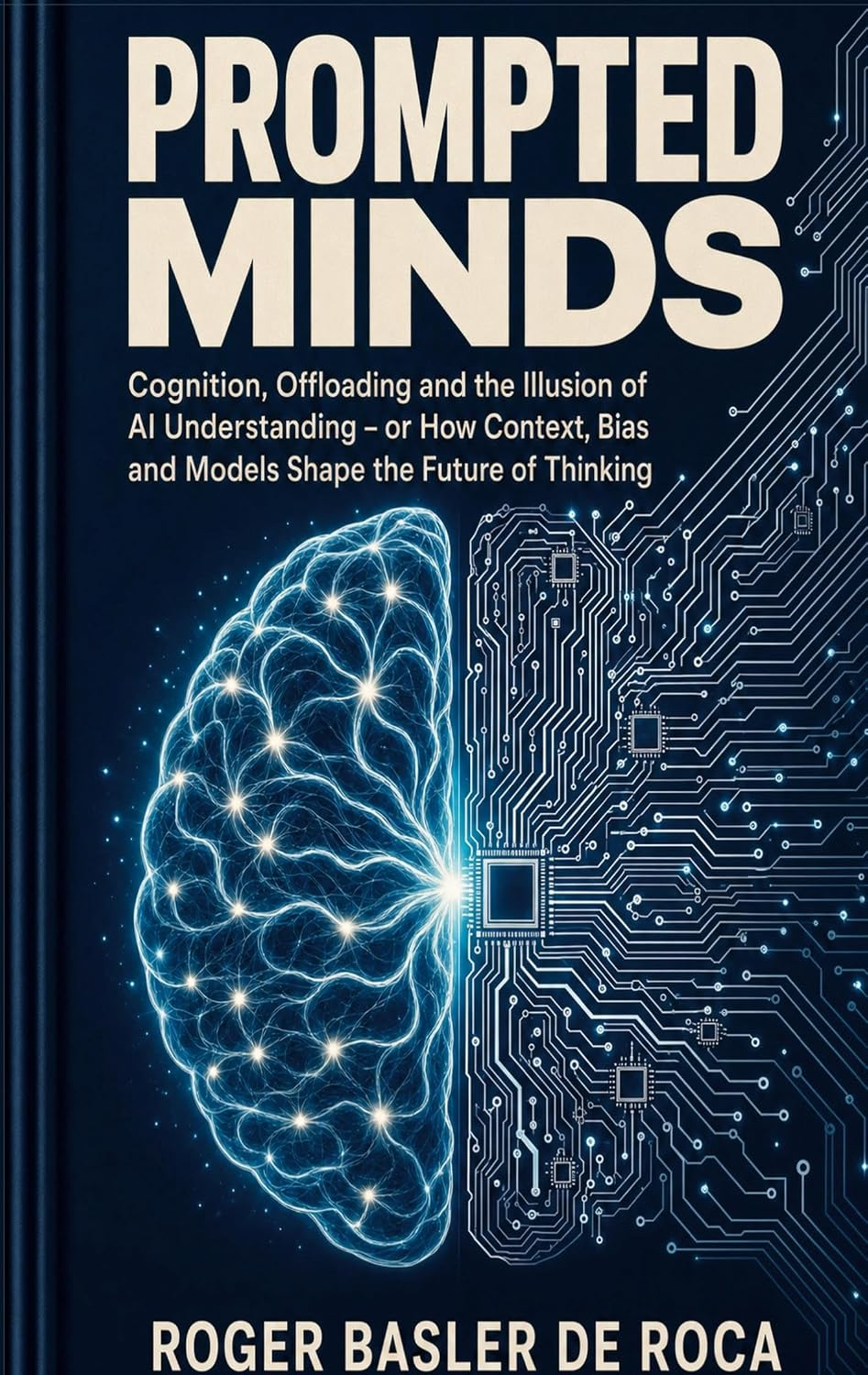
fragroger.ailinkedin.com/in/rogerbaslermail@rogerbasler.chBook: Prompted Minds
Sources
APA 7, alphabetical.
- Benedek, M., & Sziklai, B. R. (2025). Impact of AI tools on learning outcomes: Decreasing knowledge and over-reliance. arXiv. https://doi.org/10.48550/arXiv.2510.16019 Preprint
- Bjork, E. L., & Bjork, R. A. (2011). Making things hard on yourself, but in a good way: Creating desirable difficulties to enhance learning. In M. A. Gernsbacher, R. W. Pew, L. M. Hough, & J. R. Pomerantz (Eds.), Psychology and the real world (pp. 56–64). Worth Publishers. Foundations
- Brosch, H., Langer, C., Lergetporer, P., Mueller, S., Pfeifer, H., & Tschoepe, N. (2026). Task expansion with generative AI: Experimental evidence on middle-skilled, early-career workers (IZA Discussion Paper No. 18999). IZA. https://docs.iza.org/dp18999.pdf Discussion Paper
- Education International. (2026, 26. Juni). Artificial intelligence, cognitive offloading and implications for education. https://www.ei-ie.org/en/item/32652 Secondary source Secondary source for Lodge & Loble
- Eliav, N. (2026). The cognitive divergence: AI context windows, human attention decline, and the delegation feedback loop. arXiv. https://arxiv.org/abs/2603.26707 Preprint
- Favero, L., Pérez-Ortiz, J. A., Käser, T., & Oliver, N. (2026). AI in education beyond learning outcomes: Cognition, agency, emotion, and ethics. arXiv. https://arxiv.org/abs/2602.04598 Preprint
- Hardman, P. (2026, 7. August). How to design around cognitive offloading. Dr Phil's Newsletter. https://drphilippahardman.substack.com/p/how-to-design-around-cognitive-offloading Secondary source Secondary source for Cui et al., Ates, Strömberg, Dai & Chan
- Hutchins, E. (1995). Cognition in the wild. MIT Press. Foundations
- Kellogg, K. C., Lifshitz, H., Randazzo, S., Mollick, E., Dell'Acqua, F., McFowland III, E., Candelon, F., & Lakhani, K. R. (2025). Novice risk work: How juniors coaching seniors on emerging technologies such as generative AI can lead to learning failures. Information and Organization, 35(1), 100559. https://doi.org/10.1016/j.infoandorg.2025.100559 Peer-reviewed
- Kosmyna, N., Hauptmann, E., Yuan, Y. T., Situ, J., Liao, X.-H., Beresnitzky, A. V., Braunstein, I., & Maes, P. (2025). Your brain on ChatGPT: Accumulation of cognitive debt when using an AI assistant for essay writing task. arXiv. https://arxiv.org/abs/2506.08872 Preprint
- Liu, C., Guo, J., Gao, R., Chen, X., Zhu, Q., & Chang, P. (2026). Borrowed or kept? How self-generation-first and direct-adoption AI workflows shape immediate unaided reasoning. Frontiers in Psychology, 17, 1910545. https://doi.org/10.3389/fpsyg.2026.1910545 Peer-reviewed
- Risko, E. F., & Gilbert, S. J. (2016). Cognitive offloading. Trends in Cognitive Sciences, 20(9), 676–688. https://doi.org/10.1016/j.tics.2016.07.002 Foundations
- Shen, J. H., & Tamkin, A. (2026). How AI impacts skill formation. arXiv. https://arxiv.org/abs/2601.20245 Preprint
- Singh, A., Brooks, C., Li, W., Kim, J., & Wang, X. (2026). Hint-writing with deferred AI assistance: Fostering critical engagement in data science education. arXiv. https://arxiv.org/abs/2604.19931 Preprint
- Slamecka, N. J., & Graf, P. (1978). The generation effect: Delineation of a phenomenon. Journal of Experimental Psychology: Human Learning and Memory, 4(6), 592–604. https://doi.org/10.1037/0278-7393.4.6.592 Foundations
- Sourati, Z., Ziabari, A. S., & Dehghani, M. (2026). The homogenizing effect of large language models on human expression and thought. Trends in Cognitive Sciences. https://doi.org/10.1016/j.tics.2026.01.003 Peer-reviewed
- Sparrow, B., Liu, J., & Wegner, D. M. (2011). Google effects on memory: Cognitive consequences of having information at our fingertips. Science, 333(6043), 776–778. https://doi.org/10.1126/science.1207745 Foundations
- Sweller, J. (1988). Cognitive load during problem solving: Effects on learning. Cognitive Science, 12(2), 257–285. https://doi.org/10.1207/s15516709cog1202_4 Foundations
- Tao, Y., Meyer, J., & Kizilcec, R. F. (2026). Think before you accept: Can written justification reduce uncritical uptake of AI writing suggestions? arXiv. https://arxiv.org/abs/2609.23936 Preprint
- Wang, S., & Zhang, H. (2026). Pedagogical partnerships with generative AI in higher education: How dual cognitive pathways paradoxically enable transformative learning. International Journal of Educational Technology in Higher Education. https://doi.org/10.1186/s41239-026-00585-x Peer-reviewed
As of: October 2026